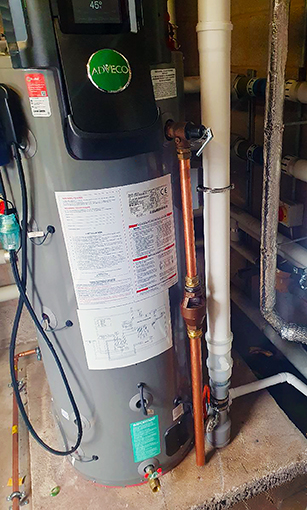
ARDENT floor standing electric boiler school installation
At the heart of this challenge is water heating - a critical service for student health and hygiene that happens to be one of the most energy-intensive and carbon-heavy components of a school’s operation. As schools juggle the trilemma of funding, decarbonisation, and maintenance, the path forward requires a pragmatic blend of immediate high-efficiency upgrades and long-term sustainability planning.
The Department for Education (DfE) and local authorities are under immense pressure to reach Net Zero. On paper, the solution is a ‘fabric-first’ approach while switching to electric systems, installing air-source heat pumps (ASHPs), and blanketing roofs with solar PV. However, the reality on the ground - or rather, in the plant room - is far more complex.
Transitioning an aged school building to a low-temperature heat pump system is rarely a ‘plug-and-play’ affair. These systems will typically require increased storage, where lower flow temperatures necessitate larger cylinders, demanding extra space that many schools simply don’t have, or first and foremost need for accommodating growing pupil numbers. The alternative are high-temperature units, which are significantly heavier, often requiring additional, and expensive structural work. Moving to an all-electric load can require expensive new grid connections and groundworks, costs that can be so prohibitive they cause renovation projects to stall entirely.
This leads to a stark choice for local authorities: do you decarbonise three schools completely with expensive electric systems, or do you renovate 12 schools by replacing failing, antiquated boilers with high-efficiency gas appliances? Given that 76% of available funding is currently swallowed by urgent maintenance and repair, the ‘many-school’ gas strategy often wins out to ensure continuity of service across the widest possible area.
The Retrofit Checklist
Retrofitting is an exercise in problem-solving. It isn't just about the heat output; it's about whether the unit can actually get into the building. When assessing a school site for a water heating upgrade, several real-world factors must be addressed, including navigating physical constraints. Do the new units fit through a standard door? Must they navigate narrow stairwells? In many cases, installing two smaller, modular units is more cost-effective and manageable than a single large appliance.
Geography will also dictate technology choices. Schools in hard water areas are better served by indirect heating to mitigate limescale. Conversely, soft water areas are prone to corrosion, requiring robust construction materials like high-grade stainless steel or advanced porcelain linings for tanks and heat exchangers. If continuing with gas, and a water heater is over 15 years old, its flue likely is too. Modern condensing appliances cannot use old negative-draught flues. Furthermore, changing regulations may mean an old terminal location is no longer compliant, requiring a complete rethink of the exhaust path.
Modern retrofits should really look to move beyond ‘dumb’ appliances. Onboard energy metering, connectivity to a Building Management System (BMS) and app-based controls allow education estate managers to monitor performance remotely and catch faults before they lead to school closures.
Bridging the Gap
While the goal is a move away from fossil fuels, high-efficiency gas remains a vital bridge for the next decade. Modern advancements in burner and heat exchanger technology have pushed thermal efficiency up to 98%.
Innovative systems, such as the Adveco Astute® condensing water heater range, have been developed specifically to address the UK’s retrofit hurdles. These units feature multiple connection points (top, back, and front), allowing them to slide into existing pipework configurations with minimal alteration. This reduces both installation time and the risk of uncovering ‘hidden’ issues like asbestos during major building works.
Furthermore, technologies like LeakSense® provide a predictive maintenance advantage. By detecting internal issues early, school managers can plan for the eventual end-of-life replacement well in advance, ensuring that the final leap to a low-carbon alternative - likely in the 2040s - is a planned transition rather than an emergency fix.
The transition to Net Zero doesn't have to be ‘all or nothing’ today. Schools can take a tiered approach to sustainability. Most modern gas appliances are already capable of running on a 20% hydrogen blend, providing a ‘green’ boost as the UK grid evolves, providing potential hydrogen readiness ‘out of the box’. Integrating solar thermal or a small heat pump as a ‘pre-heat’ source for a hybrid gas system can also significantly reduce carbon output without the larger capital expenditure of a full electric conversion. In sites where the grid allows, electric boilers offer a simpler installation than heat pumps, zero emissions, and up to a 55% reduction in carbon footprint compared to older gas systems. Again, energy and carbon savings can be increased through the introduction of solar thermal or ASHPs in hybrid configurations which can also be more compact and cost-effective than a single appliance approach.
With 80% of current school buildings predicted to still be in use by 2050, the focus must remain on making them ‘better’ today while we prepare them for the ‘best’ technology of tomorrow. Balancing the budget today ensures that critical hot water stays flowing for the students of the future.
https://adveco.co/