A range of alternative energies that include renewables, hydrogen and clean electrification can potentially replace fossil fuels in UK and EU grid systems. E-Methane is a relatively new candidate that has been identified as an additional low carbon gaseous alternative capable of performing the same role as fossil fuels.
 The importance of synthetic gasses has been elevated since the current Iran conflict. As natural gas costs are expected to rise sharply this year, economies across Europe could begin searching for cheaper gasses thar are capable of fulfilling the role of fossil fuels without emitting carbon output.
E-methane is the abbreviated name given to electro-methane, a gas which is created by extracting captured carbon dioxide and blending with green hydrogen, itself produced via renewable energy.
The number of e-methane production plants across Europe and Australia is notably increasing. Danish energy supplier, Andel, and Danish biogas company, Nature Energy, have invested DKK 100 million in constructing and operating an e-methane plant located in Glansager, Denmark.
Although not relevant to the UK and EU energy markets, Australia is the chosen location of three Japanese energy entities who are exploring e-methane production possibilities. Tokyo Gas, Toho Gas, Osaka Gas Australia (OGA) alongside Australian oil and gas company Santos have entered into an agreement that will focus on producing 130,000 tonnes of e-methane annually. This international collaboration highlights the emerging potential of e-methane.
E-methane is 1 of 14 priorities that the Japanese government’s Green Growth Strategy has highlighted as a major component towards Japanese decarbonisation objectives.
Finnish energy company Nordic Ren-Gas Oy is developing a Power-to-Gas project located in Tampere, Finland. The production facility will manufacture hydrogen and e-methane as well as provide power for local district heating sourced through waste heat. Nordic Ren-Gas Oy are actively seeking to introduce a decentralised e-methane production network throughout Finland that assists in reducing fossil fuel usage.
Several noteworthy e-methane producing plants have been constructed in Germany aiming to anticipate greater inclusion inside of domestic clean energy strategies. Germany is considered a leader in this field of expertise and has constructed 14 e-methane installations as of 2024.
One of which is the Atlantis plant located in Werlte, Lower Saxony. To acquire this project, the operator Hy2gen raised €200 million in 2022 and an additional €47 million in April 2025. This funding assisted Hy2gen in their aim of constructing a portfolio of power-to-gas projects. The Atlantis project formed part of the strategy. This facility now produces both green hydrogen and e-methane.
A further example of e-methane becoming a viable carbon neutral gas solution is demonstrated by German companies Turn2X, Siemens and Atmen collaborating to construct and bring into operation a renewable gas plant that produces e-methane from green hydrogen and biogenic CO2. The project is located in Miajadas, Spain.
E-methane is remarkably like biomethane which is produced in a separate process – methane is captured from natural biological waste and forms during a natural process called ‘anaerobic digestion.’ In the absence of oxygen microorganisms will begin to break down matter yielding a gas – methane. Once impurities are removed the methane gas becomes upgraded and biomethane is created.
 Both biomethane and e-methane are capable of identical operating behaviour when compared to fossil fuels and can therefore be placed into existing infrastructure. Biomethane and e-methane can immediately fulfil the role of fossil fuels without any fracture towards appliance operating efficiency, commercial activity, or societal cohesion.
E-methane and biomethane are potential fuels that can be used in off-grid applications also. The UK off-grid fuel market is a growing economic entity and is also a hard-to-decarbonise section of society. The UK’s gas grid network extends to 84% of UK households. Of the remaining 16%, 2 million properties are rural off grid homes and require daily fuel and power.
Off grid fuels, synthetic gasses and biogas are areas in which growth is expected to rise steadily through the up-and-coming decade.
European and the Asia-Pacific regions are refining strategies that centre on the production and distribution of e-methane and are confident that commercial sales will follow.
Biogas and synthetic gasses such as BioLPG, LPG, e-methane and Biomethane could play a discernible role in the global pursuit of clean energy. Current UK and European off grid gas markets maintain an upward trajectory.
Potential usage of alternative gasses can only increase as climate aims time limits recede, meaning that any gas capable of operational capabilities and behavioural similarities to natural gas will instantly be viewed favourably due to current infrastructure and natural gas reliance.
As the continued pursuit of low carbon energy sources continues both BioLPG and e-methane are promising variants on the road to carbon neutrality in both off grid and traditionally domestic applications in the UK and Europe.
To learn more about renewable fuels and technologies follow our free newsletter at https://www.rinnai-uk.co.uk/contact-us/newsletter-sign
Rinnai follows all domestic and international developments in current and future energy information. Doing so, provides potential customers with a solid foundation of information that assists product purchase.
Any news relating to appliance or energy options that is shaped by legislation will be immediately shared with UK customers. Access to information that affects customer judgment is an area that is Rinnai values.
RINNAI OFFERS CLEAR PATHWAYS TO LOWER CARBON AND DECARBONISATION PLUS CUSTOMER COST REDUCTIONS FOR COMMERCIAL, DOMESTIC AND OFF-GRID HEATING & HOT WATER DELIVERY
www.rinnai-uk.co.uk/about us/H3
-
- Rinnai’s range of decarbonising products – H1/H2/H3 – consists of hot water heating units in gas/BioLPG/DME, hydrogen ready units, electric instantaneous hot water heaters, electric storage cylinders and buffer vessels, a comprehensive range of heat pumps, solar, hydrogen-ready or natural gas in any configuration of hybrid formats for either residential or commercial applications. Rinnai’s H1/2/3 range of products and systems offer contractors, consultants, and end users a range of efficient, robust, and affordable low carbon/decarbonising appliances which create practical, economic, and technically feasible solutions.
- Rinnai is a world leading manufacturer of hot water heaters and produces over two million units a year, operating on each of the five continents. The brand has gained an established reputation for producing products that offer high performance, cost efficiency and extended working lives.
- Rinnai products are UKCA certified, A-rated water efficiency, accessed through multiple fuel options and are available for purchase 24/7, 365 days a year. Any unit can be delivered to any UK site within 24 hours.
- Rinnai offer carbon and cost comparison services that will calculate financial, and carbon savings made when investing in a Rinnai system. Rinnai also provide a system design service that will suggest an appropriate system for the property in question.
- Rinnai offer comprehensive training courses and technical support in all aspects of the water heating industry including detailed CPD’s.
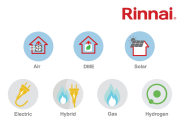
- The Rinnai range covers all forms of fuels and appliances currently available – electric, gas, hydrogen, BioLPG, DME solar thermal, low GWP heat pumps and electric water heaters More information can be found on Rinnai’s website and its “Help Me Choose” webpage.
RINNAI FULL PRODUCT AVAILABILITY 24/7 FOR NEXT DAY DELIVERY of ALL HOT WATER HEATING UNIT MODELS INCLUDING 48-58kW UNITS-
SAVINGS OF
20% REDUCTION of Opex Cost,
30% REDUCTION of initial cost
15% REDUCTION in carbon
75% REDUCTION of space
Visit www.rinnai-uk.co.uk
Or email engineer@rinaiuk.com
For more information on the RINNAI product range visit
www.rinnaiuk.com